
Guidebook
- Home
- Guidebook
Mastering the AI SEO: How Treatment Centres Can Lead with AI SEO
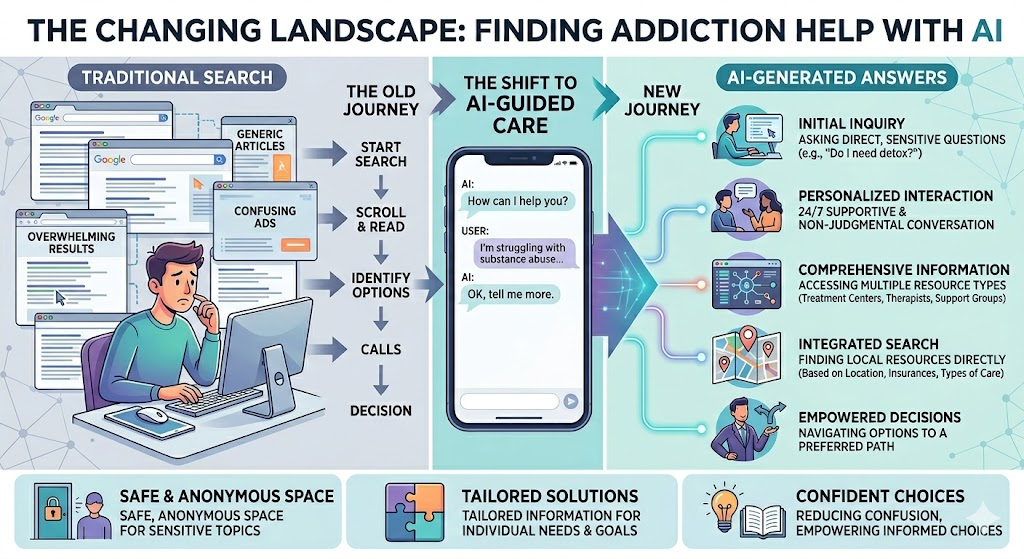
The way people find help for addiction is changing. Traditional search results are no longer the only starting point; instead, prospective patients are turning to AI-generated answers to navigate their most sensitive questions. AI SEO is the practice of ensuring your facility is not only found but chosen and accurately represented by these AI systems.
For those managing drug rehab promotions, the goal has shifted from merely ranking for keywords to becoming a trusted entity that AI engines like Google’s AI Overview, ChatGPT, and Perplexity consistently cite.
The Journey of a Functioning Alcoholic: A Case Study in AI Search
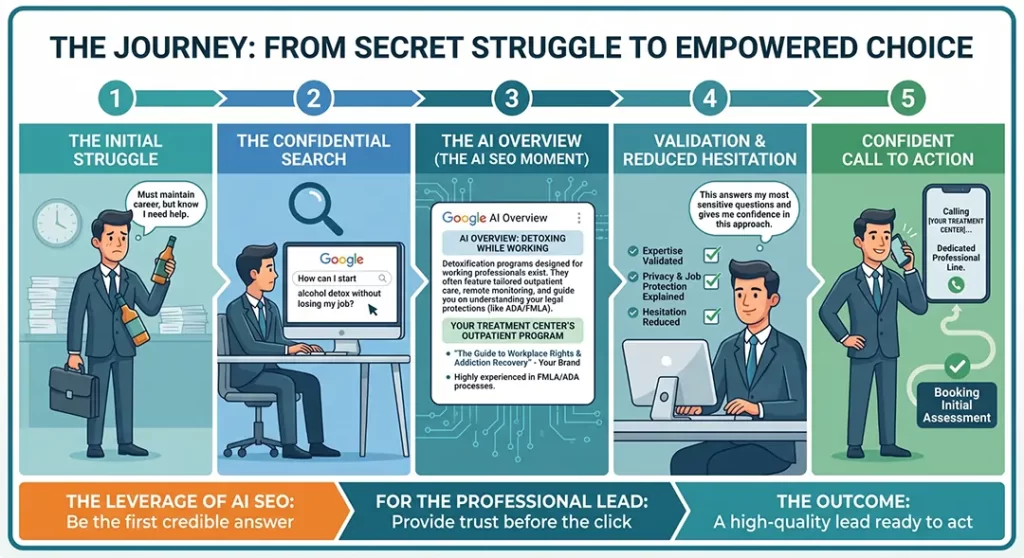
Consider a professional lead—a high-functioning individual who maintains a demanding job but struggles with alcohol dependency. He knows he needs help to live a normal life and keep his career, but he is hesitant to call a facility directly. Instead, he turns to Google and asks: “How can I start alcohol detox without losing my job?”
In this moment, the Google AI Overview synthesizes a response. If your treatment center has optimized for AI SEO, the AI might mention your specific outpatient detox program or your guide on “Workplace Rights and Addiction Recovery”. This lead isn’t just looking for a link; he is looking for a credible answer that validates your brand’s expertise before he ever clicks through to your site.
1. Prioritize Direct Answers and BOFU Content
AI engines prioritize content that provides clear, direct value. To capture the attention of a lead researching alcohol detox, your content must:
- Answer directly: Place your core answer in the first 40–60 words of a section before providing further detail.
- Focus on Bottom-of-the-Funnel (BOFU) content: Create transactional guides, such as “Top Outpatient Alcohol Detox Centres in [City]” or “Medical Detox vs. Home Detox: What’s Safer?”.
- Use natural language: Write headings that match the specific, conversational questions patients actually ask.
2. Build Authority Through Brand Mentions and AI SEO Citations
In the world of AI SEO, AI citations and brand mentions on third-party platforms are the new currency of authority.
- Engage where the AI looks: AI engines heavily cite platforms like Reddit (43% of citations), YouTube, and Wikipedia. Establishing a presence in subreddits where individuals discuss recovery can significantly influence how AI perceives your brand.
- Consistency is key: Your “entity footprint”—the consistency of your name, address, and phone number across the web—must be flawless. If details are inconsistent, AI may provide inaccurate information to leads.
- Original Research: Publishing data-backed insights about recovery trends can increase the likelihood of your facility being cited as a thought leader.
3. Technical Foundations for AI Retrievability
If AI crawlers cannot easily read your site, your facility will not appear in the AI Overview.
- Use Schema Markup: Implement FAQ, Article, and HowTo schema to help AI understand the structure and meaning of your content.
- Ensure Clean HTML: Use logically structured headlines and semantic HTML to make your site easy for Large Language Models (LLMs) to parse.
- Speed and Accessibility: Fast-loading pages and content that isn’t hidden behind complex design elements or pop-ups are essential for “retrievability”.
4. Measuring Success Beyond the Click
Success in AI SEO is measured by share of voice and the sentiment of AI responses. You should track:
- Mentions: How often your brand appears in AI-generated answers even without a link.
- Citations: How often those mentions include a clickable source back to your website.
- Sentiment: Whether the AI describes your treatment options in a positive or neutral light.
By focusing on these AI SEO strategies, your treatment center can move from being just another search result to being the recommended solution for those, like our professional lead, who are searching for a way back to a normal life.
In the upcoming installments of this series, we’ll dive deep into the technical frameworks and promotional strategies essential for mastering AI-driven SEO.
How do I implement FAQ schema for my treatment centre?
Implementing FAQ schema is a critical technical foundation for AI SEO because it helps Large Language Models (LLMs) easily interpret the structure and meaning of your content. For a treatment center, this ensures that when a lead asks a specific question about alcohol detox or recovery, the AI engine can confidently retrieve your answer.
To implement FAQs schema effectively, follow these steps:
1. Identify the Right Questions
- Gather questions from admissions call recordings, and customer research. Insurance coverage, family program, mobile use, pet-friendly these are some of the main concerns of the callers. You can create FAQs around these questions.
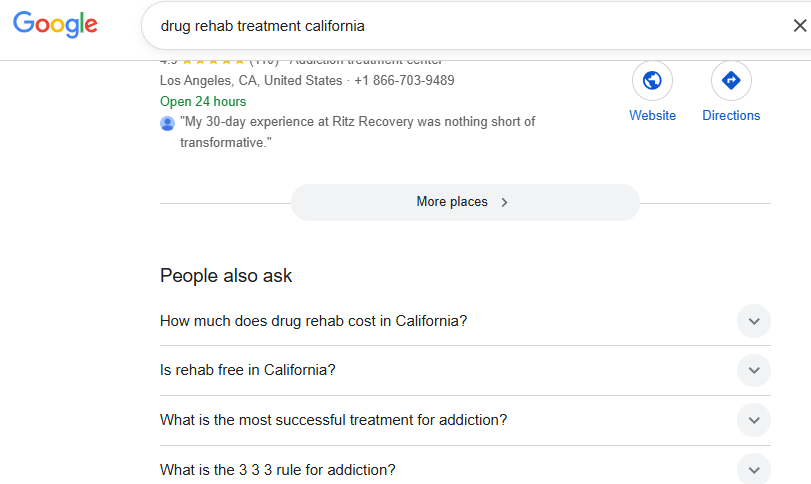
- Look at Google’s “People Also Asked” section for terms related to your services.
When you are creating content for “drug rehab treatment california”, you can create FAQs for queries like- What is the Cost of treatment
- What is 3-3-3 rule for addiction
- What is the Cost of treatment
- For a professional lead—such as the functioning alcoholic mentioned in our previous discussion—focus on transactional, bottom-of-the-funnel (BOFU) questions like, “How can I attend detox while keeping my job?” or “What are the success rates of outpatient programs?”.
2. Draft AI-Friendly Answers
AI engines prioritize content that is direct and easy to extract.
- Use Natural Language: Write headers and subheadings that match how people naturally ask questions.
- The 40–60 Word Rule: Place your core answer in the first 40–60 words of the section before providing additional detail.
- Make Sections Self-Contained: Since AI engines extract individual passages, each FAQ should make sense on its own.
- Use Scannable Formats: Incorporate bullets, numbered lists, or tables within your answers to improve retrievability.
3. Apply the Technical Schema Markup
Once the content is ready, you need to wrap it in structured metadata so LLMs can “read” it.
- Structured Data: Use FAQ schema markup (typically in JSON-LD format) to tell the AI that these are specific questions and answers.
- Clean HTML: Ensure your site uses clean, semantic HTML and logically structured headlines (H1, H2) to make it easier for crawlers to parse.
- Site-Wide Metadata: Ideally, your technical setup should eventually allow for auto-generated, site-wide metadata to help LLMs understand the meaning of your entire domain.
4. Optimize and Scale
To maintain your presence in the AI Overview, you must treat AI SEO as an ongoing practice rather than a one-time task.
- Use AI Workflows: You can use AI-assisted workflows to generate and add FAQs to your website at scale, but always keep a human in the loop to ensure quality and prevent hallucinations.
- Maintain Freshness: Most AI citations point to content updated within the last 10 months; ensure your detox protocols and facility details remain current.
- Monitor Performance: Track your brand mentions and citations in AI responses to see if your FAQs are being used as a source.
By implementing this structured data, you increase your “shots on goal” for being cited in AI overviews and appearing in responses on platforms like ChatGPT and Perplexity. This helps build brand mentions and AI SEO citations across the web, establishing your facility as a trusted authority for those seeking a path back to a normal life.
How can I build topical authority for my rehab center?
Building topical authority for a rehab centre in the age of Answer Engine Optimization (AI SEO) requires moving beyond traditional keyword targeting to becoming a trusted, comprehensive source of information that AI engines consistently cite.
Based on the sources, here is how you can build and maintain that authority:
1. Shift from Keyword Research to Question Mapping
Traditional SEO focuses on phrases, but AI SEO authority is built by answering the full range of questions your prospects actually ask.
- Source your questions: Mine your admissions call recordings, notes from referral meetings and the “People Also Asked” section on Google to identify the specific concerns of your audience.
- Create transactional and BOFU content: Focus 80% of your effort on bottom-of-the-funnel (BOFU) guides. For a rehab center, this might include “Inpatient vs. Outpatient Detox for Professionals” or “How to maintain career privacy during alcohol treatment“.
- Use natural language: Write headers and subheadings as direct questions to match how humans interact with AI engines like ChatGPT and Gemini.
2. Focus on "Topical Coverage" Over "Keyword Injection"
AI engines assess authority based on how thoroughly you cover a subject.
- Identify Topic Gaps: Use tools or manual research to review 40–50 competitors for a single topic (e.g., “alcohol detox”). Identify entities and sub-topics they cover that you might be missing.
- Content Splintering: If a page is ranking poorly for a specific high-intent keyword, “splinter” it off into its own dedicated page. This expands your keyword footprint and ensures a one-to-one intent match for the user.
- Build a Knowledge Base: Create a centralized brand knowledge base that houses your facility’s unique expertise. This ensures all new content is grounded in your brand’s specific knowledge and doesn’t sound like “generic AI fluff”.
3. Establish Off-Site Popularity and "Entity" Trust
In AI SEO, authority is expressed as widespread, positive mentions in plain text on other authoritative sites.
- Target High-Retrieval Sources: AI engines heavily cite specific platforms. Reddit is cited about 43% of the time, followed by Wikipedia (40%) and YouTube. Establish an active presence on these platforms by answering questions and building community.
- Secure Listicle Placements: Reach out to sites that publish “top 10” or “best of” lists for treatment options like gorehabs.com. Being included in these third-party listicles is a major signal to Large Language Models (LLMs) that your brand is a leader in its category.
- Publish Original Research: AI engines and humans alike value proprietary data. Sharing unique insights or data-backed recovery trends increases the likelihood of your facility being cited as a primary source.
4. Maintain a Consistent "Entity Footprint"
For an AI to trust your rehab center as an authority, it must clearly understand who you are across the entire web.
- Clean Up Brand Details: Ensure your name, address, phone number (NAP), and brand descriptions are 100% consistent across all directories, social profiles, and industry outlets.
- Technical Signalling: Use Article Schema to help LLMs identify your thought leadership content and FAQ Schema to signal that you are providing direct answers to specific queries.
5. Daily Authority Maintenance
Authority is not a one-time project but an ongoing practice.
- Update Content Regularly: The majority of ChatGPT’s citations point to content updated within the last 10 months.
- Monitor Mentions: Use tools to track how often your brand is mentioned in AI-generated answers compared to your competitors. This “share of voice” is a key metric for measuring your growing topical authority.
What are the benefits of publishing original data for AI SEO?
Publishing original data and proprietary research is a primary driver for building topical authority and increasing visibility within AI-generated responses. In the context of Answer Engine Optimization (AI SEO), unique data serves as a high-value signal that distinguishes your brand from generic, AI-generated “fluff”.
The following are the key benefits of publishing original data for AI SEO:
1. Increased Likelihood of Citations and Mentions
AI engines, such as ChatGPT, Perplexity, and Google’s Gemini, are programmed to prioritize and cite sources that provide unique insights and proprietary data.
- Direct Quotability: By highlighting key facts, statistics, and short claims, you provide “retrievable” content that engines can quote directly in their summaries.
- Standing Out: Unique data carries more weight in answer engines because it allows your brand to stand out from competitors who may only be repurposing existing information.
2. Establishing Authority and Trust
Sharing data-backed insights is a critical component of establishing your brand as a thought leader in your industry.
- Valuable to Humans and AI: Original research is considered “especially valuable” to both human readers and Large Language Models (LLMs).
- Expert Voice: Building authority through expert voices and original data leads to widespread positive mentions across the web.
3. Creating Multi-Source Consensus
For an AI to confidently recommend a brand, it looks for consensus across multiple trusted platforms.
- Industry Conversations: Ideally, your original research becomes a central part of broader industry conversations, leading to your brand being widely cited by others.
- Third-Party Validation: When other authoritative sites, industry publications, or forums like
- Reddit discuss and cite your data, it reinforces to LLMs that your brand is a credible and consistent source.
4. Improving "Share of Voice"
In AI SEO, success is measured by share of voice—how often your brand appears in AI-generated answers relative to your competitors.
- Citations vs. Mentions: Original data helps bridge the gap between being mentioned (appearing in an answer) and being cited (having a clickable link back to your site).
- Driving High-Quality Traffic: Because AI-referred traffic often comes from users who have already consumed your data and compared alternatives, these leads frequently convert at higher rates.
By consistently publishing original data, your treatment center ensures it is not just “found” by AI but is chosen as the authoritative source for answering complex user queries.
Which metrics best track original data success in AI answers?
To track the success of original data within AI-generated answers, you must move beyond traditional SEO metrics like keyword rankings and focus on how Large Language Models (LLMs) attribute and value your unique insights. Because AI engines rewrite content into paragraphs rather than displaying a ranked list of links, success is measured by your brand’s presence and authority within these generated narratives.
The following metrics are the most effective for tracking the impact of original research and proprietary data in Answer Engine Optimization (AI SEO):
1. Mentions and Citations
These are the primary indicators of whether your original data is being used by AI engines.
- Mentions: This tracks how frequently your brand name appears in an AI-generated answer, even if a clickable link is not provided.
- Citations: This is a critical metric for original data. It measures how often the AI includes a clickable source link back to your website alongside a mention of your data. If your brand has high mentions but low citations, it suggests your content is being used but is not structured in a way that the AI finds easy to attribute.
2. Share of Voice (SOV)
Share of voice measures your brand’s mention rate relative to your competitors across the same set of prompts. Original data is a powerful tool for increasing SOV because unique, data-backed insights allow your brand to stand out from competitors who may only offer generic information.
3. Sentiment and Accuracy
Because AI engines can sometimes misinterpret information, it is vital to track the qualitative nature of your mentions.
- Sentiment: Use third-party tools to monitor whether AI platforms describe your brand and data in a positive, neutral, or negative light.
- Accuracy: This tracks how accurately the AI represents your proprietary facts and brand narrative.
4. AI Referral Traffic and Conversion Rates
Ultimately, the success of your data should be reflected in the quality of traffic it drives to your site.
- AI Referrals: Track the volume of visitors arriving specifically from answer engines like ChatGPT, Gemini, and Perplexity.
- Conversion Rates: Leads arriving via AI search often have more context and have already compared alternatives. For example, HubSpot found that leads coming from AI SEO converted 3x better than those from traditional channels.
5. Brand Visibility Score
Some platforms provide a consolidated Brand Visibility Score that aggregates your frequency of appearance, sentiment, and competitive standing across major answer engines. Monitoring this score week-over-week helps determine which pieces of original research are successfully “moving the needle” in AI visibility.
By focusing on these metrics, you can ensure your original data is not only being found by AI but is being used to build a credible, cited brand narrative that converts high-intent leads.
How do I identify which retrieval sources AI currently trusts?
Identifying which retrieval sources an AI engine trusts requires a combination of manual reverse-engineering and automated citation analysis to understand the “entity footprint” the AI is following.,
Here is how you can identify these trusted sources for your treatment center:
1. Conduct Manual Prompt Engineering
The most direct way to see what an AI trusts is to ask it.
- Run Commercial Queries: Use platforms like ChatGPT, Perplexity, and Google’s Gemini to run queries relevant to your market, such as “best professional alcohol detox programs.”
- Extract and Pattern-Match Citations: Look specifically at the links and sources the AI provides in its answers. Identify which domains, industry outlets, or third-party blogs keep appearing across different prompts.
- Identify Missing Opportunities: Note where your competitors are mentioned but your brand is missing; these “missing sources” represent your primary promotion opportunities.
2. Prioritize High-Trust "Human-Centric" Platforms
Current data indicates that AI engines place immense trust in platforms featuring authentic, human conversations.
- The “Big Three”: Research shows that Reddit is cited approximately 43% of the time, followed by Wikipedia (40%) and YouTube as the third most cited source.
- Property Bias: AI engines often prioritize their own properties; for instance, Google’s LLMs give significant credit to YouTube content.
- Authority Hubs: AI also looks at LinkedIn, industry-specific outlets, review sites, and affiliate partner blogs to build a multi-source consensus.
3. Perform Competitor Retrieval Research
To understand the “grounding” of AI responses in your niche, you should analyze the competitive landscape.
- Analyze Citations: Use tools to see which specific content types and source channels are influencing AI responses in your category.
- Competitor Deep-Dives: Review 40 to 50 competitors for a single high-intent keyword to extract which entities and topics are being covered and cited most often.
- Identify Topic Gaps: By seeing what sources the AI currently trusts for your competitors, you can find gaps where they aren’t providing coverage and create superior, data-backed assets to claim that citation.
4. Leverage Specialized AI SEO Tools
Instead of manual tracking, which can be inefficient, use dedicated AI SEO software to automate the discovery process.
- Citation Analysis: Modern AI SEO tools can automatically run daily prompts and log which domains and sources are being cited in your industry.
- Visibility Scoring: These tools can provide an AI Visibility Score, showing your brand’s recognition and competitive standing across major engines like ChatGPT and Perplexity.
- Sentiment Tracking: Beyond just the link, these tools track the sentiment of the mention, helping you identify if the trusted source is representing your brand positively.
By identifying these retrieval sources, you can focus your off-site efforts on the platforms that have the highest impact on your share of voice in AI-generated answers.
How do I reverse-engineer AI citations for my center?
Reverse-engineering citations is a fundamental pillar of drug rehab promotions, as it allows you to identify exactly which third-party websites and platforms AI engines trust to validate your services. By understanding why certain sources are chosen, you can strategically place your brand where AI engines are most likely to “retrieve” it.
To reverse-engineer AI citations for your treatment center, follow these steps:
1. Execute "Commercial" Prompt Engineering
Begin by running the exact queries your potential leads would use in AI engines like ChatGPT, Perplexity, and Gemini. For example, use a query a professional lead might ask: “What are the most reputable outpatient alcohol detox centres for executives?”.
- Extract the Citations: Manually log every source the AI provides in its response.
- Analyze Source Types: Determine if the AI is citing listicles, news articles, academic research, or community forums.
2. Identify Trusted Retrieval Hubs
AI engines do not view all websites equally; they have a high “property bias” and trust specific platforms for authentic human insights.
- Reddit and Wikipedia: Research indicates Reddit is cited approximately 43% of the time, followed by Wikipedia at 40%. Establishing a presence in relevant subreddits where individuals discuss recovery can lead to more frequent AI SEO citations.
- YouTube: As a Google property, YouTube is a major trust signal and the third most cited source.
- Industry Listicles: AI frequently pulls from “top 10” lists. Identify which listicles your competitors appear in and reach out to those sites for inclusion.
3. Conduct Competitor Entity Analysis
To see why competitors are being chosen over your center, you must analyze their “entity footprint”.
- Review 40–50 Competitors: For a high-priority keyword like “alcohol detox,” analyze the top 40–50 ranking pages to see which entities and sub-topics they cover.
- Identify Topic Gaps: Use tools like Rankability or HubSpot to find what these cited competitors are talking about that you aren’t. If a competitor is cited for a specific “transactional” guide, you should create a superior version of that asset.
4. Monitor Brand Mentions and Sentiment
In AI SEO, a brand mention is valuable even without a clickable link because it builds the “multi-source consensus” AI engines look for.
- Track Mentions: Use tools like Google Alerts or specialized AI SEO dashboards to monitor how often your brand is mentioned across the web.
- Analyze Sentiment: Ensure the mentions are positive. AI engines track whether your center is described favorably in the sources they retrieve.
5. Leverage Automated AI SEO Tools
Manual research can be inefficient, so utilizing dedicated software is recommended for scaling your strategy.
- HubSpot AI SEO Tool: This tool can run your target prompts daily, log every response, and show you exactly who the AI is citing in your category.
- Grounded Data: Look for tools that provide grounded data—insights based on real web search results rather than just the LLM’s internal training data.
By identifying these missing sources, you turn them into your primary promotion opportunities. This ensures that when a lead seeks help to keep their job and live a normal life, your center is the authoritative source the AI consistently recommends.
How can I monitor my brand's sentiment in AI results?
Monitoring your brand’s sentiment in AI results is a vital component of AI SEO, as it ensures that Large Language Models (LLMs) are representing your business accurately and favorably. Unlike traditional SEO, which focuses on clicks, AI SEO requires tracking the qualitative nature of how AI engines describe your brand within their generated narratives.
You can monitor and manage your brand’s sentiment through the following methods:
1. Utilize Specialized AI SEO and Brand Tracking Tools
Traditional and new specialized tools can help you track how your brand is being mentioned across the web and within AI interfaces:
- AI SEO-Specific Tools: Platforms like HubSpot’s AI SEO tool run daily prompts relevant to your market across engines like ChatGPT, Gemini, and Perplexity. This tool provides a dashboard that specifically tracks sentiment patterns and how your brand’s favorability compares to competitors.
- AI SEO Grader: You can use the AI SEO Grader for a quick snapshot report that scores your brand’s sentiment, recognition, and competitive standing.
- Brand Monitoring Software: Beyond AI SEO-specific tools, you can use Google Alerts (free), Brand 24, or Ahrefs Brand Radar. The Ahrefs Brand Radar is particularly useful as it looks at AI overviews and various AI modes to see how your brand is being mentioned.
2. Analyze Qualitative AI Responses
Because AI “rewrites” content into paragraphs rather than just providing links, you must evaluate the narrative context of the responses.
- Monitor Favourability: Regularly check whether AI platforms describe your brand in a positive, neutral, or negative light.
- Track Accuracy: It is essential to measure the accuracy of the mentions. If an AI has “grounding” from incorrect third-party sources, it may repeat wrong or unfavorable information about your entity.
- Multi-Source Consensus: AI engines build trust by looking for consistent information across multiple trusted sources like Reddit, Wikipedia, and YouTube. Ensuring your brand messaging is consistent across these platforms helps the AI generate a more stable and positive sentiment.
3. Establish a Baseline with Prompt Tracking
To get a clear picture of your sentiment, you should:
- Define Target Prompts: Identify the specific questions your potential patient ask when researching for treatment.
- Run Daily Prompts: Manually or through automation, run these prompts to see how your brand is being positioned.
- Identify Sentiment Gaps: Look for patterns where the AI might be citing a competitor more favorably or using outdated information to describe your services.
By monitoring these sentiment patterns and acting on prioritized recommendations, you can move your brand from simply being found to being the one chosen by both the AI and the end user.
What is the 40-60 word rule for AI answers?
The 40–60 word rule is an AI SEO best practice designed to help AI engines easily find, understand, and retrieve your content. It dictates that you should place your core answer in the first 40–60 words of a section before providing any further detail or elaboration.
This rule is particularly effective when used in conjunction with the following strategies:
- Lead with Natural Language: Structure your content using question-based headers that match how people naturally ask for information.
- Self-Contained Sections: Since AI engines tend to extract individual passages, each section—starting with that 40–60 word direct answer—should make complete sense on its own.
- Prioritize High-Traffic Pages: When starting with AI SEO, a recommended first step is to identify your highest-traffic page and add these direct, concise answers at the beginning of each relevant section.
By following this rule, you increase the likelihood that your content will be successfully retrieved and cited in AI-generated answers, such as those found in Google’s AI Overviews, ChatGPT, or Perplexity.
How can I check my center's AI visibility score?
You can check your treatment center’s AI visibility score primarily through specialized AI SEO tools that track your presence across platforms like ChatGPT, Gemini, and Perplexity.
1. HubSpot AI SEO Tool
The most direct way to establish and monitor a score is through the HubSpot AI SEO tool. For a $50/month subscription, this tool automates the tracking process:
- Set up Prompts: You define the specific questions your prospective patients (such as professionals seeking detox) ask when researching treatment.
- Daily Monitoring: The tool runs these prompts daily across multiple answer engines, logging every response.
- Visibility Dashboard: It updates a dashboard with your Brand Visibility Score, which measures how often and how favorably your brand appears.
- Competitive Analysis: You can compare your score against other rehab centers to identify “visibility gaps” where competitors are being cited instead of you.
2. Free Snapshot Tools
If you are looking for an immediate, one-time assessment, you can use these resources:
- AEO Grader: This provides a quick snapshot report that scores your sentiment, recognition, and competitive standing across answer engines.
- Webflow AI SEO Maturity Assessment: A free tool at https://webflow.com/blog/aeo-maturity-model that assesses your site’s overall maturity and provides concrete recommendations for improvement.
3. Alternative Monitoring Platforms
Other technical tools can help you triangulate your visibility and “share of voice”:
- Ahrefs Brand Radar: This tracks how your brand is being mentioned specifically within AI overviews and various AI modes.
- Rankability: This tool pulls research from both traditional and AI search environments, helping you see which entities (like your center are being prioritized in the real world.
- Google Alerts and Brand 24: While more traditional, these free or paid tools help you monitor the brand mentions across the web that AI engines use to build their “multi-source consensus”.
What the Visibility Score Tracks
Your score is a qualitative measure of presence in conversations rather than just a ranking. It measures:
- Mentions: How often your center appears in an AI answer without a link.
- Citations: How often those mentions include a clickable source back to your site.
- Sentiment: Whether the AI’s description of your services is positive, neutral, or negative.
By tracking this score week-over-week, you can see which of your drug rehab promotions or content updates are successfully “moving the needle” in AI visibility.
Which entities and topic gaps should I address first?
To effectively prioritize which entities and topic gaps your treatment center should address first, you should follow a strategy that combines optimizing existing “low-hanging fruit” with a heavy focus on bottom-of-the-funnel (BOFU) content that directly answers patient questions.
According to the sources, your first priorities should be:
1. Optimize "Low-Hanging Fruit" Entities
Start with content that is already performing relatively well but hasn’t reached its full potential.
- Identify 2–15 Rankings: Use Google Search Console to find keywords where your center ranks between positions 2 and 15.
- Improve Topical Coverage: Instead of “keyword stuffing,” review these pages to see if you are missing key entities that top competitors are covering. Use a content optimization tool to analyze 40–50 competitors for a specific keyword to see which entities show up most frequently across best-performing results.
- Add Strategic Sections: Often, addressing a topic gap means adding a new sentence, paragraph, or entire section that provides better coverage of the subject naturally.
2. Prioritize High-Intent BOFU Topics
For a treatment center, the most valuable entities are those that lead to a “one-to-one intent match” for a lead.
- Focus on the 80/20 Split: Shift your strategy so that 80% of your content is bottom-of-the-funnel (BOFU) or transactional, and only 20% is generic informational content.
- Address Specific Professional Concerns: In the case of a lead trying to keep his job while seeking help, you should prioritize topic gaps such as:
- “Executive outpatient alcohol detox programs.”
- “Inpatient vs. Outpatient detox for professionals” (Versus content).
- “Workplace rights and addiction recovery” (Transactional guides).
- Answer Direct Questions: Identify questions from sales call recordings, support tickets, and “People Also Asked” sections. For example, “How can I attend detox without losing my job?” is a critical question-based entity to address first.
3. Address Gaps in Your "Entity Footprint"
Your facility is considered an “entity” by AI, and its consistency across the web influences trust.
- Clean Up Brand Details: Ensure your name, address, and phone number (NAP) and brand descriptions are consistent across all profiles, directories, and social properties. If these sources are inconsistent, AI may provide inaccurate information to users.
- Identify Missing Third-Party Citations: Run commercial queries in AI engines like ChatGPT and Perplexity to see where your competitors are mentioned but you are missing. These “missing sources” (such as industry listicles or specific subreddits) are your primary promotion opportunities.
4. Technical Entity Signaling
To ensure AI engines “understand” the entities you are addressing, you must use technical metadata.
- Highest-Traffic Page First: Identify your highest-traffic page and add FAQ schema with question-based headers and direct 40–60 word answers.
- Use Schema Markup: Implement Article schema to help AI identify your thought leadership and Product/Service schema to clarify the structure of your treatment options.
By first addressing these low-hanging fruit keywords, high-intent transactional questions, and off-site mention gaps, you can quickly improve your brand’s visibility and ensure that leads searching for help receive accurate and authoritative answers about your facility.
How can I improve the 'retrievability' of my content?
Improving the retrievability of your content is a core technical and structural pillar of Answer Engine Optimization. It focuses on making your website easy for Large Language Models (LLMs) to find, crawl, and interpret so they can accurately surface your information in AI-generated answers.
The following strategies will help enhance your content’s retrievability:
1. Strengthen Technical Foundations
AI crawlers cannot retrieve information they cannot read or access.
- Use Clean, Semantic HTML: Ensure your site uses a clear and logically structured hierarchy with proper headlines (H1, H2, etc.) and metadata.
- Implement Structured Data: Use schema markup—specifically FAQ, HowTo, Article, and Product schema—to help answer engines understand the meaning and structure of your pages.
- Optimise Technical Files: Maintain updated sitemap.xml and robots.txt files, and consider adding an llms.txt file to specifically assist LLMs in understanding your content.
- Prioritise Speed and Accessibility: Fast-loading pages are more retrievable. Avoid “blocking” answer engines and ensure your most important information is not tucked away in complex design elements, hidden code, or pop-ups.
2. Structure Content for Extraction
Since answer engines often extract individual passages rather than full pages, your content must be formatted for easy “snacking” by AI.
- Follow the 40–60 Word Rule: Put your core answer in the first 40–60 words of a section before adding further elaboration.
- Lead with Natural Language: Write headings and subheadings as direct questions, definitions, or comparisons that match how users (and engines) look for information.
- Make Sections Self-Contained: Every section should provide value on its own so that it makes sense when an AI pulls it out as a standalone snippet.
- Use Scannable Formats: Favor bullet points, numbered lists, and tables over long, dense paragraphs to improve retrievability for structured queries.
3. Focus on Topical Coverage and Intent
Content that is too broad or outdated is less likely to be retrieved as an authoritative source.
- Ensure Freshness: Keep your content current; the vast majority of ChatGPT’s citations point to content updated within the last 10 months.
- Improve Topical Coverage Naturally: Review your pages for “entity gaps”—sub-topics or keywords your competitors are covering—and add strategic sentences or paragraphs to improve the page’s relevance.
- Splinter Content for Intent Match: If a page ranks poorly for a specific query because the intent doesn’t perfectly match, splinter off that topic into its own dedicated page to create a “one-to-one intent match”.
- Strengthen Internal Linking: Link relevant pages across your site to show the AI that you have deep topical authority on a subject.
4. Build Off-Site "Entity" Consistency
The AI’s ability to retrieve your brand information is also influenced by your footprint across the wider web.
- Consistent Entity Footprint: Ensure your brand’s name, address, phone number, and descriptions are 100% consistent across all profiles, directories, and third-party sites.
- Multi-Source Consensus: AI engines trust content that is validated by multiple sources; therefore, being mentioned on high-retrieval platforms like Reddit, Wikipedia, and YouTube significantly boosts your visibility.
How can I improve my center's off-site entity footprint?
Improving your center’s off-site entity footprint is essential for Answer Engine Optimization because Large Language Models (LLMs) do not just summarize your website; they decide which brands to represent based on information pulled from sources they trust. For a professional lead—like the functioning alcoholic researching options—seeing your brand validated across multiple authoritative platforms builds the “multi-source consensus” AI engines require to recommend you.
Here is how you can systematically improve your centre’s off-site presence:
1. Audit and Standardize Your "Entity" Details
Your brand is an “entity,” and AI systems need a consistent “entity footprint” to describe you accurately.
- Fix NAP Consistency: Every day, spend time cleaning up your Name, Address, and Phone number (NAP) across all relevant profiles, directories, and social properties.
- Align Brand Descriptions: Ensure your facility’s mission, treatment philosophy, and service details are consistent everywhere. If this information is fragmented, AI systems may provide inaccurate or conflicting details to users.
2. Target High-Retrieval Platforms
AI engines place significant trust in platforms where they find authentic, human conversations.
- The “Big Three”: Focus on Reddit (cited approximately 43% of the time), Wikipedia (40%), and YouTube.
- Engage in Discourse: For your rehab centre, you should establish a presence in subreddits where recovery is discussed. Have a community manager answer questions authentically without spamming, as AI engines parse these conversations to understand brand sentiment.
- Visual Authority: Since YouTube is a Google property, being cited there is a massive trust signal for Google’s own AI products.
3. Secure Listicle Placements and AI SEO Citations
AI answers often function as synthesized listicles. If you are not in the sources the AI is reading, you will not be in the answer.
- Identify Citation Gaps: Run commercial queries like “best executive detox centres” in Gemini, ChatGPT or Perplexity, extract the citations, and see which sources appear consistently.
- Outreach: If specific industry listicles are cited but your center is missing, reach out to those publishers to get included. These AI SEO citations provide the “grounding” the AI needs to mention your brand.
- Value Brand Mentions: Even if you cannot get a followed link, a brand mention in plain text on an authoritative retrieval source still significantly influences AI visibility.
4. Establish Thought Leadership with Original Data
Publishing unique, proprietary research is one of the most effective ways to get cited by others and AI alike.
- Share Unique Insights: Publish data-backed insights on recovery trends or success rates. LLMs view original research as “especially valuable” and are more likely to quote these key facts directly.
- Spokesperson Outreach: Have your medical directors or specialists appear on podcasts and write guest posts. These “expert voices” contribute to the widespread positive mentions AI engines look for.
5. Monitor Your Off-Site Sentiment
Success in AI SEO is measured by mentions, share of voice, and sentiment rather than just traditional rankings.
- Use Monitoring Tools: Use tools like Google Alerts, Brand 24, or the HubSpot AI SEO tool to track how your brand is being discussed on third-party sites.
- Check Accuracy: Regularly verify if AI is representing your center correctly. If an AI has “grounding” from a wrong or outdated third-party source, its output will be wrong as well.
By ensuring your center appears consistently and positively across the web, you increase the chances that when a professional lead asks an AI for help, your facility is the one chosen.
How can I implement an llms.txt file for my site?
Implementing an llms.txt file is a key part of building the technical foundations for successful Answer Engine Optimization. Along with other technical files like robots.txt and sitemap.xml, the llms.txt file is designed to help Large Language Models (LLMs) easily understand the structure and meaning of your website’s content.
To implement this effectively for your site, follow these guidelines based on the sources:
- Establish the Technical Foundation: Place the llms.txt file in your site’s root directory, similar to how you manage your robots.txt file. This ensures that when AI crawlers visit your site, the file is easily discoverable.
- Provide Structural Metadata: Use the file to describe your content’s structure. This helps the AI understand how your information is organized, which is critical because answer engines often extract individual passages rather than full pages.
- Enhance Retrievability: The primary goal of this file is to ensure retrievability. If AI crawlers cannot easily “read” or retrieve your page data, your treatment centre will not be surfaced in AI responses. Ensure the information in your llms.txt is clean and directly points to your most important, high-intent content.
- Prevent Blocking: Use your technical setup to ensure you are not accidentally blocking answer engines. The llms.txt file works as a signal that your site is “AI-friendly” and ready to be parsed for information.
- Coordinate with Schema: For maximum impact, your llms.txt should complement your schema markup (such as FAQ and Article schema). While schema provides structured data for specific elements, the llms.txt file provides a broader map for the LLM to follow.
By implementing this file, you are moving toward a mature technical setup that eventually allows for auto-generated, site-wide metadata, making it significantly easier for AI to choose your brand as an authoritative source.
What is 'content splintering' and how does it improve intent?
Content splintering is a high-leverage SEO and AI SEO strategy that involves taking a page that is ranking poorly (typically beyond position 50) for certain keywords and building a new, dedicated page specifically for those terms.
This process improves intent in the following ways:
- Creates a One-to-One Intent Match: Often, keywords for which a page ranks poorly do not actually match the intent of the current asset. By splintering these keywords off into their own dedicated page, you ensure the content is a perfect match for the user’s specific query.
- Fixes “Unrankable” Assets: If a page is simply the “wrong asset” for a specific keyword, no amount of optimization will help it rank; splintering addresses this by creating the correct asset from scratch.
- Supports the Original Page: This move does not just help the new keyword; it supports the original page by removing irrelevant intent and allowing both pages to focus on their specific topics.
- Expands Keyword Footprint: It allows you to broaden your reach by ensuring you have specialized content for a wider variety of searches, which is especially effective when a page is already appearing in the top 100 results but lacks a strong intent match.
In practice, this strategy allows you to scale your content creation by focusing on actual market data from Google Search Console, ensuring every new asset you publish is highly relevant to what users are searching for.
Embracing AEO ensures your treatment centre is not just found by those in need but actively chosen as their trusted path to recovery. By consistently refining your “entity footprint” and providing direct, data-backed answers, you secure your place as a leader in the evolving AI search landscape